When Do You Need to Register for GST/HST in Canada? The $30,000 Rule Explained (2026)
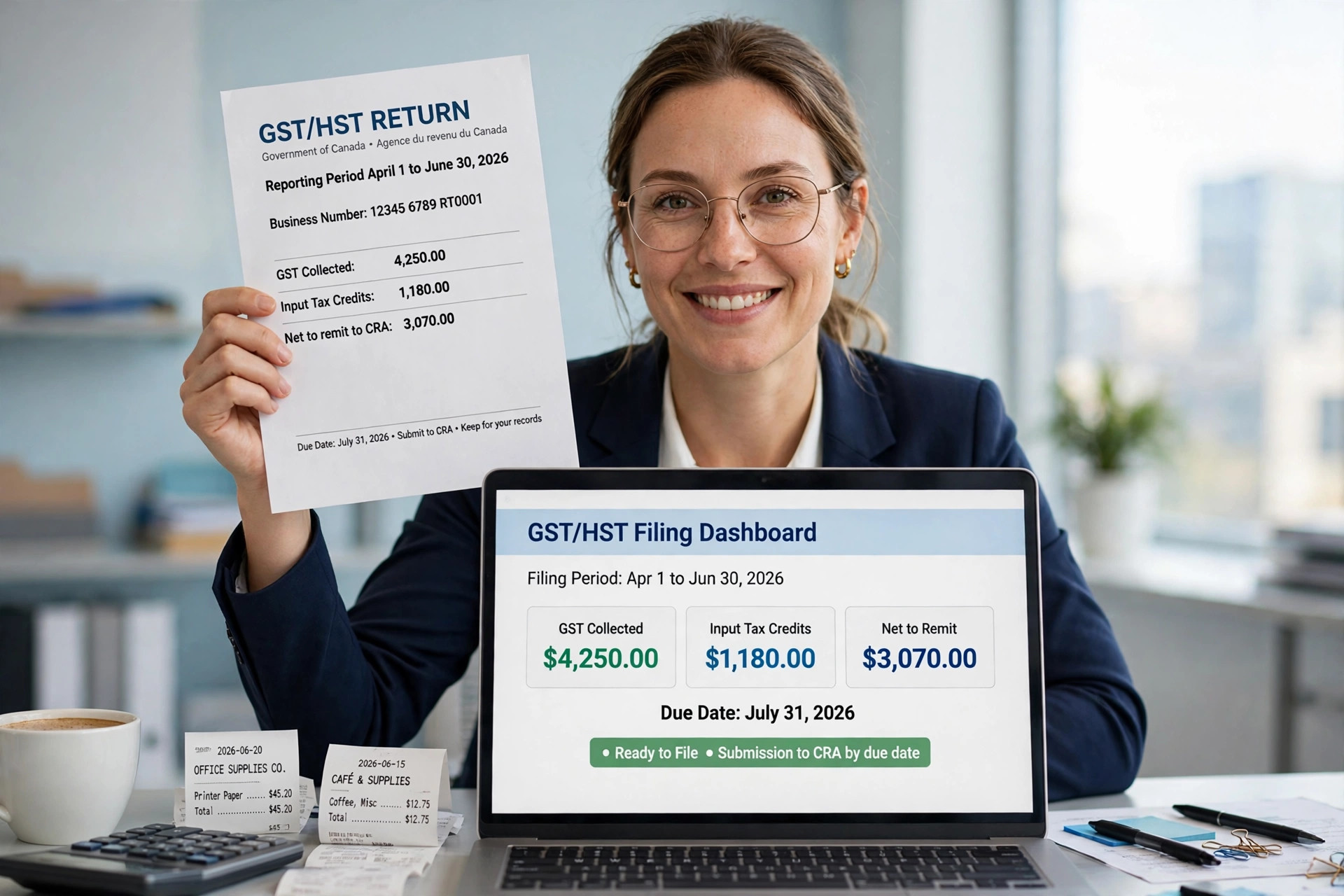
The GST/HST $30,000 threshold is the line that decides when to register for GST/HST in Canada. Once your worldwide taxable supplies pass $30,000, either in a single calendar quarter or over four consecutive calendar quarters, you are no longer a small supplier. Below that line registration is optional. Above it, registration is mandatory, you must start charging GST/HST from your effective date, and you have 29 days to apply for registration with the Canada Revenue Agency (CRA). This guide explains the GST/HST $30,000 rule in plain language: the two tests, what counts toward the $30,000, when you start charging, what it costs to register late, and when registering early actually saves you money. It applies across Canada, with a Surrey and BC angle where the rules differ by province.
The Short Answer
If your business makes taxable supplies in Canada, the CRA expects you to register for GST/HST as soon as you stop being a small supplier. That happens in one of two ways. First, if your taxable supplies exceed $30,000 in any single calendar quarter, you stop being a small supplier on the very sale that takes you over, and you charge GST/HST on that sale. Second, if your taxable supplies exceed $30,000 across four consecutive calendar quarters without any single quarter doing it, you stop being a small supplier at the end of the month after that fourth quarter, and you charge GST/HST on your first taxable supply after that date. In both cases, the tax you owe starts from your effective date, not from the day you finally get around to registering. Registering late does not move the start date. It only moves the bill, and the CRA can assess the uncollected tax, plus penalties and interest, back to the date you should have started charging.
What Is the Small Supplier Rule?
The Excise Tax Act says every person who makes a taxable supply in Canada in the course of a commercial activity must register for GST/HST, except where that person is a small supplier. Being a small supplier is the exemption, and the $30,000 test is how the CRA decides whether you still qualify for it.
A small supplier is a business whose worldwide taxable supplies, including zero-rated supplies, together with those of its associates, do not exceed $30,000 in a single calendar quarter or over the four preceding consecutive calendar quarters. Public service bodies, such as municipalities, universities, hospitals and school authorities, have a higher limit of $50,000. For most small businesses in Surrey and across BC, the number that matters is $30,000.
Three points in that definition catch people out. First, the test uses calendar quarters, January to March, April to June, July to September and October to December, even if your business uses a different fiscal year. Second, it counts gross revenue before expenses, not profit. A reseller who turns over $40,000 in sales with only $6,000 of margin is over the threshold. Third, it counts worldwide taxable supplies, not just Canadian sales. If you sell to customers in the USA, the UK or anywhere else, those taxable sales count toward the $30,000 too.
The Two Tests That Decide Registration
The GST threshold is really two tests, and they have different deadlines. You must register if you fail either one.
| Test | How it works | When you stop being a small supplier |
|---|---|---|
| Single quarter test | Taxable supplies exceed $30,000 in one calendar quarter | Immediately, on the sale that takes you over |
| Four quarter test | Taxable supplies exceed $30,000 across four consecutive calendar quarters, with no single quarter over $30,000 | At the end of the month following the quarter that takes you over |
| Neither test failed | Taxable supplies stay at or below $30,000 in every quarter and across every four-quarter window | You stay a small supplier, and registration is optional |
Test 1: Over $30,000 in a single quarter
One strong quarter is enough. If your taxable supplies in a single calendar quarter exceed $30,000, you are no longer a small supplier, and your effective date of registration is no later than the day of the supply that took you over. You must charge GST/HST on that very supply. A Surrey contractor who lands a $35,000 job in the April to June quarter, for example, must charge GST on that job, even if it is the only job of the quarter. The CRA gives you 29 days to apply for registration after you stop being a small supplier.
Test 2: Over $30,000 across four quarters
If your revenue creeps past $30,000 gradually, you get a short grace period. Say a freelance designer bills $8,000 a quarter for four quarters. That is $32,000 across the four quarters, with no single quarter over $30,000. Small supplier status ends at the end of the month following the quarter that took the total over $30,000. If that fourth quarter ends September 30, the status ends October 31, and the effective date is the first taxable supply after that date. Charge GST/HST from that supply onward, and apply for registration within 29 days.
The rolling window is the part most owners miss. The four-quarter test is not January to December. It is any four consecutive calendar quarters, checked again every quarter. A business that earned $28,000 in 2025 can still cross the line in early 2026 if the last four quarters together pass $30,000. Check the rolling total at the end of every quarter, not once a year at tax time.
What Counts Toward the $30,000?
Not every dollar your business receives counts. The CRA counts taxable supplies, and it leaves some things out. Getting this list right is the difference between registering a year too early and registering a year too late.
| Counts toward the $30,000 | Does not count |
|---|---|
| Taxable sales of goods and services in Canada | Exempt supplies, such as most health care, education and long-term residential rent |
| Zero-rated supplies, such as most exports and basic groceries, taxed at 0 percent | Sales of capital property, such as selling a business vehicle or equipment you used in the business |
| Worldwide taxable supplies, including sales to customers outside Canada | Sales of goodwill when you sell the business |
| Sales by businesses associated with you, where the CRA treats them as associates | Supplies of financial services, such as lending money or selling shares |
| Sales made before expenses are deducted, because the test uses gross revenue | Gifts, personal money you put into the business, and loans |
Two rows deserve a closer look. Zero-rated supplies count toward the threshold even though you charge 0 percent tax on them. An exporter in Surrey who ships $40,000 of goods to the USA is over the threshold and must register, even though no GST is charged on those exports. Registration then works in the exporter's favour, because a registrant can claim input tax credits on the GST/HST paid on business purchases. Exempt supplies are different. If you make only exempt supplies, you generally cannot register for GST/HST at all, and you cannot claim input tax credits on the tax you pay. A business that mixes taxable and exempt supplies needs to track the split, because only the taxable part counts toward the $30,000.
Associates also count. If you control another business, or another business controls yours, the CRA may add the associates' taxable supplies to yours for the test. A sole proprietor cannot restart the $30,000 limit by opening a second business under another name. If you run more than one business, talk to your bookkeeper before assuming each one gets its own $30,000.
Who Has No Threshold at All?
Two groups do not get the $30,000 exemption. Taxi drivers and commercial ride-sharing drivers must register for GST/HST from their first dollar of fares. There is no small supplier threshold for them. The same applies to a business that makes only taxable supplies and is already required to register for another reason, such as a non-resident business that carries on business in Canada. If you drive for Uber or Lyft in Surrey or Vancouver, register before your first fare, not after your first $30,000.
When Do You Start Charging GST/HST?
Your effective date of registration decides the first sale you charge tax on, and it depends on which test you failed.
| How you crossed $30,000 | Effective date | First sale to charge |
|---|---|---|
| In a single calendar quarter | No later than the day of the supply that took you over | That very supply |
| Across four consecutive quarters | Your first taxable supply after the end of the month following the quarter that took you over | That first supply after the grace month |
| Voluntary registration, below $30,000 | The date you choose when you register | The first taxable supply on or after that date |
If you register late, the CRA still treats you as registered from your effective date. That means you owe the GST/HST on every taxable supply from that date, whether or not you charged it to the customer. Most customers will not pay tax on an old invoice months later, so the tax usually comes out of your own pocket. That is why the $30,000 rule is a cash problem, not just a paperwork problem. A bookkeeper who tracks the rolling four-quarter total each month spots the crossing before it happens, so the tax goes on the invoice while the customer is still expecting to pay it.
How to Register for GST/HST
Registration itself is straightforward. You apply through the CRA's Business Registration Online service, or by phone or by mail using Form RC1. You will need your Business Number, or the CRA will issue one, and you will open a GST/HST account, which the CRA calls an RT account. Your GST/HST account number is your 9-digit Business Number followed by RT0001, for example 123456789 RT0001, and you put that number on your invoices once you are registered. Most small businesses can complete the online registration in about 15 to 20 minutes and receive the number straight away. The CRA generally assigns an annual reporting period when you register, though you can choose a more frequent one.
Before you register, decide your fiscal year for GST/HST purposes, because your reporting period follows it. Most sole proprietors use the calendar year, ending December 31. A corporation usually uses its corporate year-end. Keep the GST/HST fiscal year the same as your income tax fiscal year where you can, because mismatched year-ends create extra returns and extra chances to miss a deadline.
Our GST/HST filing service covers registration, filing and remittance, so the threshold tracking and the return are handled together. If you are already behind, catch-up bookkeeping gets the records current first, so the registration date and the backdated tax can be worked out from real numbers instead of guesses.
Should You Register Before You Hit $30,000?
Registration below $30,000 is voluntary, and for many small businesses it pays. The main reason is input tax credits, known as ITCs. Once you are registered, you can claim back the GST/HST you paid on business purchases, such as software, equipment, rent, professional fees and supplies. If your business spends a lot on taxable inputs, those credits can be worth more than the tax you collect. A new business that buys a $2,000 laptop in BC pays $100 of GST on it. Unregistered, that $100 is a cost. Registered, it is a credit against the tax collected, and it can turn a return into a refund.
Voluntary registration is not right for everyone. The trade-offs are simple.
| Register early | Stay unregistered below $30,000 |
|---|---|
| Claim ITCs on business purchases, which can turn returns into refunds | No GST/HST returns to file and no tax to charge customers |
| Look established to larger clients, some of whom expect a GST/HST number on invoices | No risk of charging the wrong rate or missing a filing deadline |
| Start the habit of tracking GST/HST while the business is still small | Keep pricing simple, which matters if your customers are consumers who cannot claim the tax back |
| Build a clean filing history before the business grows | Avoid the admin until the revenue justifies it |
Register early if you buy a lot of taxable inputs, if your customers are mostly businesses that can claim the tax back, or if you are close to the threshold and will cross it within a few months anyway. Stay unregistered if your customers are mostly consumers, your inputs are small, and your revenue is well below $30,000 with no growth in sight. Either way, track the rolling four-quarter total monthly. The decision to stay unregistered only works if you know the moment it stops being an option.
What Rate Do You Charge in BC and Across Canada?
GST/HST rates depend on where the supply is made, not where your business is based. A Surrey business that sells to a customer in Ontario charges Ontario HST on that sale. The rates for 2026 are:
| Province or territory | Rate to charge |
|---|---|
| British Columbia | 5 percent GST, plus 7 percent PST charged separately under BC law |
| Alberta, Manitoba, Saskatchewan, Yukon, Northwest Territories, Nunavut | 5 percent GST |
| Ontario | 13 percent HST |
| New Brunswick, Newfoundland and Labrador, Prince Edward Island | 15 percent HST |
| Nova Scotia | 14 percent HST |
| Quebec | 5 percent GST, plus QST charged separately under Quebec law |
BC is the point that trips up Surrey owners most often. GST and PST are separate taxes. GST is the federal 5 percent, filed with the CRA. PST is the provincial 7 percent, filed with the BC government, and it has its own registration rules and its own small seller rules. Your BC PST return goes to the BC government on its own schedule, separate from your GST/HST return. Registering for GST/HST does not register you for PST, and passing the $30,000 GST/HST threshold does not automatically mean you must register for PST. Check both taxes separately, and keep them on separate lines on your invoices so customers and your bookkeeper can see which is which.
How Often Do You File, and When Is It Due?
The CRA assigns your reporting period from your annual taxable supplies. Most small businesses file once a year.
| Annual taxable supplies | Assigned reporting period | Return due |
|---|---|---|
| $1,500,000 or less | Annual | 3 months after your fiscal year-end |
| More than $1,500,000 up to $6,000,000 | Quarterly | 1 month after each quarter ends |
| More than $6,000,000 | Monthly | 1 month after each month ends |
You can elect to file more often than the CRA assigns, which helps if you usually receive refunds, because you get the money back sooner. You cannot elect to file less often. Every registrant must file a return for every reporting period, even a period with no sales and nothing to claim. That is called a nil return, and skipping it still counts as late filing. GST return filing follows the same schedule: the return reports the GST/HST you collected, minus the input tax credits you are claiming, and the difference is what you pay or what the CRA refunds you.
The Quick Method
The Quick Method is a simpler way to work out what you owe. Instead of tracking every input tax credit, you charge GST/HST at the normal rate and remit a fixed percentage of your sales to the CRA. It is available to businesses with $400,000 or less in annual taxable supplies, and the percentage depends on your business type and province. The Quick Method suits service businesses with few taxable expenses, because the bookkeeping is much lighter. It does not suit businesses that buy a lot of taxable inputs, because you give up the right to claim input tax credits on those purchases, and the credits are usually worth more than the time saved. If you are not sure which method leaves more money in your pocket, ask your bookkeeper to run both numbers before you elect it.
Annual filers with a December 31 year-end have a split deadline that catches people out. For sole proprietors, the GST/HST payment is due April 30 and the return is due June 15. Paying on June 15, the filing date, means the payment is already six weeks late, and interest runs from May 1. For corporations, both the return and the payment are generally due 3 months after the fiscal year-end. Put both dates in your calendar, not just the filing date.
What Does Late Registration and Late Filing Cost?
Late registration costs you the tax you should have collected, and late filing adds a penalty and interest on top. The CRA calculates the late filing penalty as 1 percent of the amount owing, plus 25 percent of that 1 percent for each complete month the return is late, up to 12 months. The maximum penalty is 4 percent of the amount owing. No penalty applies when nothing is owing or when the CRA owes you a refund. Interest is charged separately on any overdue amount, at the CRA prescribed rate, compounded daily from the day after the due date. For October 1 to December 31, 2026, the prescribed rate on overdue GST/HST is 7 percent, and the CRA resets the rate every quarter.
A worked example makes the cost concrete. Say you owe $10,000 of GST/HST and file 6 months late. The penalty is $100, which is 1 percent of $10,000, plus $150, which is 0.25 percent of $10,000 for each of the 6 months. That is $250 in penalties, and interest at 7 percent compounded daily is charged on top, from the day after the payment was due until the day you pay. The penalty alone is small. The real cost of late registration is usually larger: the tax on every sale from your effective date that you never charged, which you now owe from your own pocket.
If you receive a demand to file and still do not file, the CRA can charge a further $250 penalty and can issue an estimated assessment, which is the CRA guessing what you owe and billing you for it. An estimated assessment is almost always higher than the real number, and you still have to file the real return to correct it. Filing on time, even if you cannot pay in full, is always cheaper than not filing.
Common GST/HST Mistakes in BC
- Treating $30,000 as a calendar year figure. It is a rolling four-quarter test, checked every quarter. A business can cross it in March, not December.
- Counting profit instead of gross revenue. The test uses sales before expenses. A low margin business crosses the line much sooner than its owner expects.
- Forgetting worldwide sales. Export sales and sales to US customers count, even though they are zero-rated.
- Charging PST and GST as one number. In BC they are separate taxes with separate registrations and separate returns.
- Paying the annual return on June 15. For sole proprietors, the payment is due April 30. The return is due June 15. Interest runs from May 1.
- Registering and then not filing nil returns. Every reporting period needs a return, even with no sales. Skipped nil returns still draw penalties when tax is owing later.
- Waiting for the CRA to tell you to register. The CRA does not send a warning at $29,000. The obligation starts when you cross the line, whether or not anyone reminds you.
Do You Need a Bookkeeper for GST/HST?
You can register and file GST/HST yourself, and many owners do while the business is small. A bookkeeper earns the fee in three places. First, tracking the rolling four-quarter total every month, so registration happens on time and the tax goes on the invoice while the customer is still there to pay it. Second, keeping the ITC records clean, so every claim has a receipt behind it and the CRA cannot deny it for missing paperwork. Third, handling GST return filing on time every period, including nil returns, so penalties and interest never start. Our monthly bookkeeping service includes GST/HST tracking and filing, and our guide on bookkeeper vs accountant in Canada explains which one your business needs first. For the full record keeping list, see our small business bookkeeping checklist for BC.
Frequently Asked Questions
Published by Majoka Accounting Ltd., Surrey, BC. This article is general information, not tax advice. Speak to a professional about your specific situation.
Book a Free Consultation
Not sure whether you need to register for GST/HST yet? Tell us your last four quarters of sales and we will check the threshold for you, with a fixed monthly price and no obligation.